
Acceptance Authority Governance
Where Execution Becomes Financial Commitment
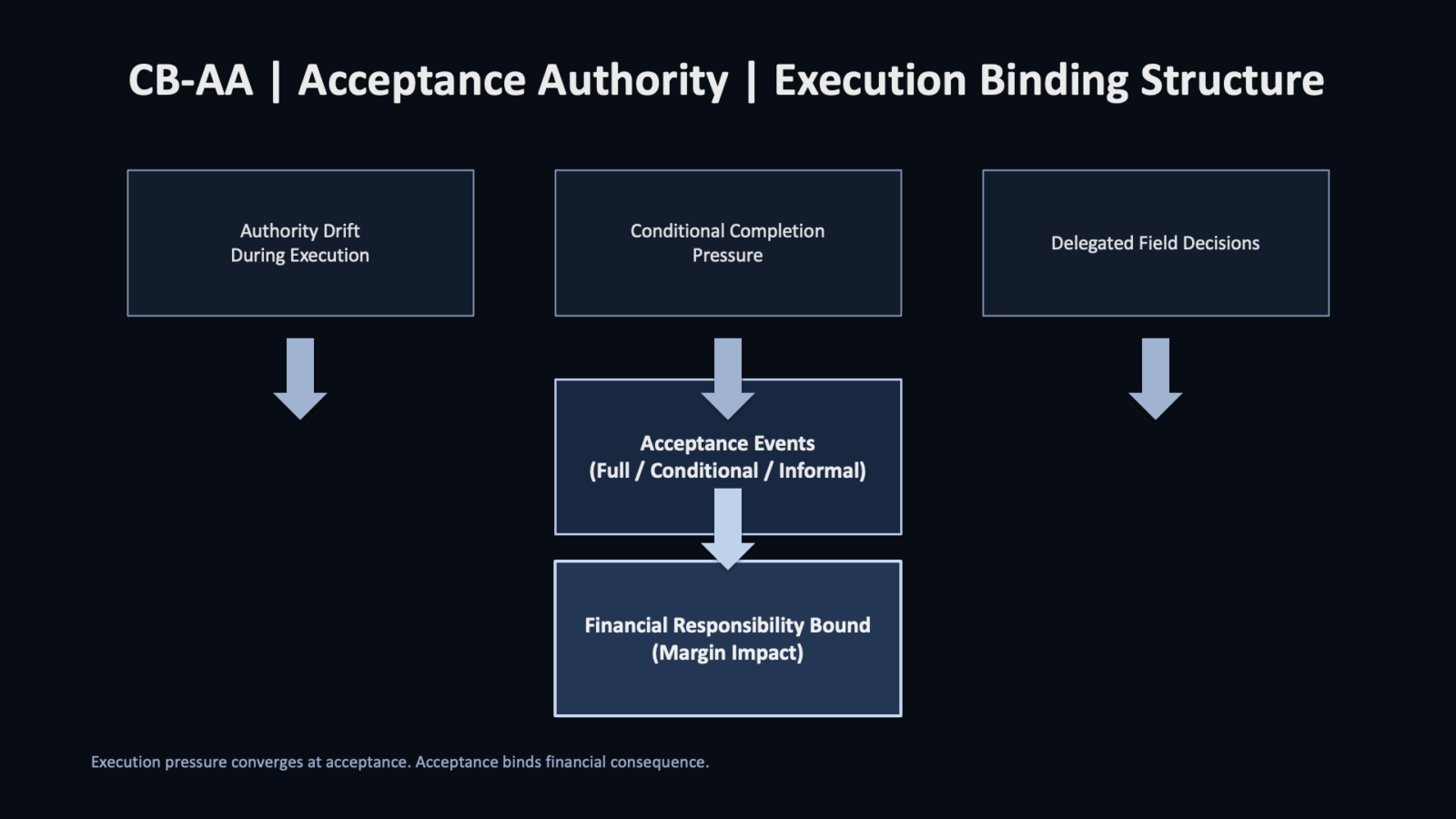
Execution pressure does not bind cost directly. Financial consequence forms at the moment work is accepted.
Authority drift, conditional completion, and delegated field decisions accumulate during delivery, yet they become financially binding only when acceptance occurs.
Once acceptance is exercised, financial responsibility attaches whether it was priced, attributed, or escalated properly.
Acceptance authority therefore becomes the structure that determines whether margin remains intact or begins to compress.
Acceptance takes different forms:
• Formal documented acceptance
• Conditional acceptance pending clarification
• Informal operational sign-off
• Milestone confirmation without full commercial reconciliation
Each carries consequence.
When acceptance authority is exercised without clear commercial alignment and escalation discipline, financial responsibility migrates silently into the cost base.
Structural Flow
The CB-AA Acceptance Authority structure illustrates how execution pressure converges into binding acceptance events that attach financial responsibility.
Margin Formation Example
Operational Context
During a power generation program approaching commissioning, conditional completions, deferred scope items, and commercial accommodations were exercised across multiple work packages to preserve delivery continuity.
Acceptance Behavior
Each approval remained within delegated authority limits and appeared proportionate when assessed individually. Across reporting cycles, incremental approvals accumulated while operational performance remained stable and escalation thresholds were not triggered.
Financial Formation
Forecast margin moved from approximately 12.5 percent to 9.4 percent through cumulative acceptance rather than a single operational event. Reconstruction later confirmed that delegated thresholds had been applied individually without consolidated exposure visibility, demonstrating that acceptance discipline determines whether margin compression stabilizes or compounds.
Relationship to Execution Margin Formation
Execution Margin Formation explains how authority drift and conditional exposure form under pressure.
Acceptance Authority governs the precise moment where those forces convert into financial impact.
Relationship to Decision Authority
Acceptance binds cost during execution.
Decision authority determines whether that binding survives insurance review, lender diligence, or valuation scrutiny.
Acceptance authority governs how work is approved during execution. Decision authority determines whether those approvals ultimately bind the institution when the record is examined under capital scrutiny.
Engagement Position
Engagement is most effective when:
• Conditional acceptance volume is increasing
• Escalation discipline has softened
• Margin variance is emerging without clear root cause
• Close-out reconciliation is widening
Acceptance authority intervention restores financial alignment before compression hardens.
→ Engage