
Capital-Bound Authority Architecture (CB-AA)
Designing Authority Conditions That Remain Intact Under Capital Compression
Authority is exercised in environments where financial consequence may not be immediately visible. Discretion appears proportionate at the moment it is granted, yet its cumulative effect gradually shapes capital posture over time. When those decisions later surface under supervisory examination, refinancing review, transaction diligence, insurance recovery, or regulatory inquiry, the durability of the authority structure determines the institution’s resilience.
Capital-Bound Authority Architecture defines how discretion remains structurally aligned with capital constraint across both formation and examination phases. It operates as a governing layer above operational systems and model governance frameworks, focusing on whether authority exercised within those systems remains bounded by financial exposure when scrutiny intensifies.
CB-AA does not prescribe how decisions should be made. It defines the structural conditions required for those decisions to remain attributable when capital scrutiny reconstructs them later.
Authority is exercised once. Architecture determines whether it remains defensible when scrutiny arrives.
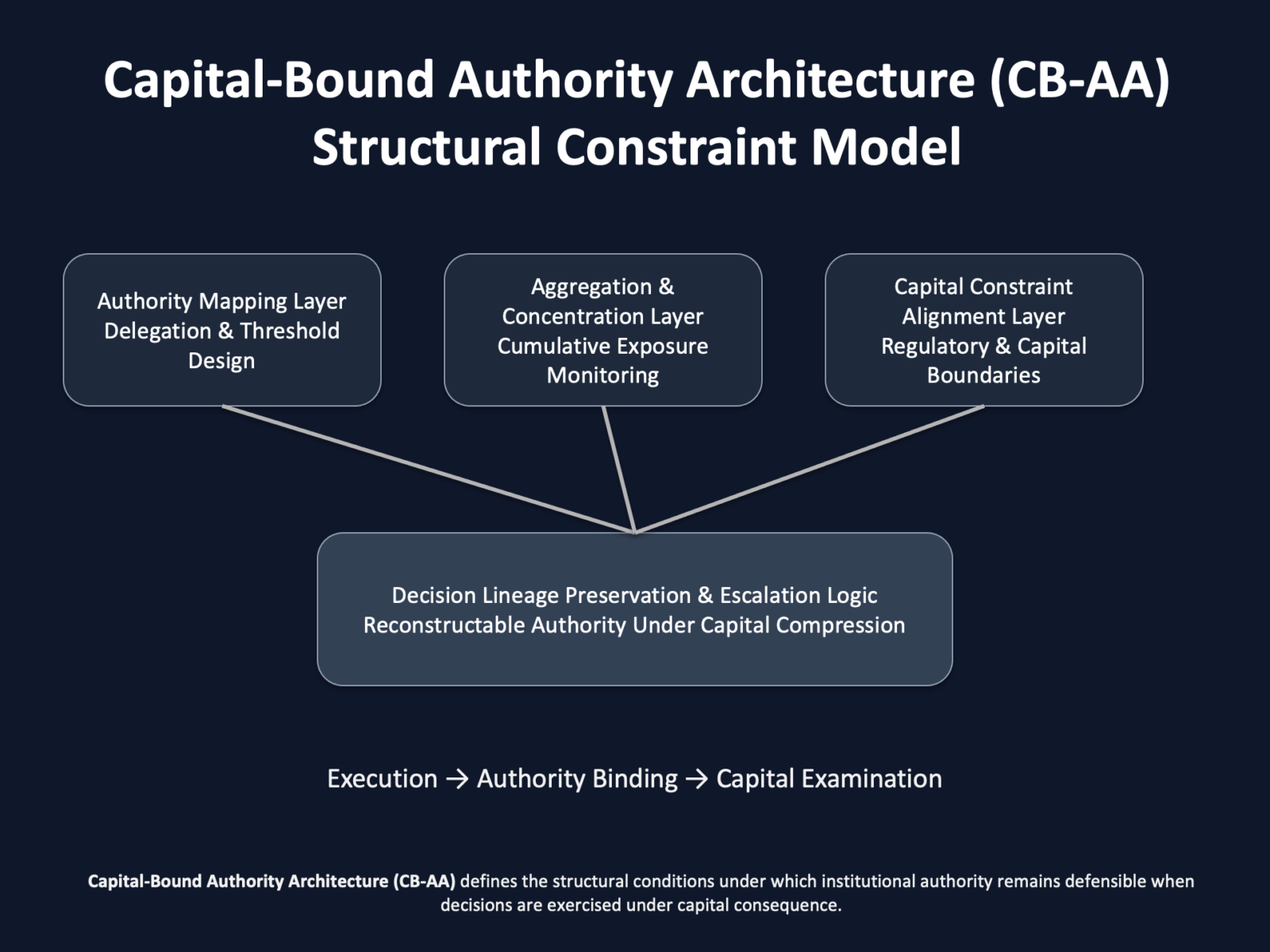
The CB-AA Structural Constraint Model illustrates how authority conditions remain aligned with capital constraints as discretion is exercised across delivery cycles.
Governing Thesis
Capital-Bound Authority Architecture establishes the structural conditions under which institutional discretion remains aligned with capital constraint across time.
Exposure accumulates when delegated authority scales without structural aggregation against capital limits. Individually proportionate decisions can collectively influence capital adequacy, concentration profile, liquidity resilience, or covenant stability. Override activity that appears immaterial in isolation may gradually reshape institutional risk posture when viewed across cycles.
Capital-Bound Authority Architecture binds discretion to defined capital thresholds at the moment of exercise and preserves the conditions necessary for reconstruction when review accelerates.
Structural Components
Authority Mapping Layer
This layer defines delegation thresholds, decision classifications, sector exposure boundaries, and escalation alignment. Authority is mapped to explicit financial parameters rather than assumed operational hierarchy. Each exercise of discretion is anchored to a defined boundary that reflects capital relevance.
Aggregation & Concentration Layer
This layer evaluates cumulative override and approval activity across reporting periods and exposure categories. Individual decisions are assessed within their broader capital context, ensuring that incremental discretion does not produce structural concentration drift. Aggregation logic transforms isolated decisions into a unified visibility framework.
Capital Constraint Alignment Layer
Decision activity is continuously aligned with capital-sensitive constraints, including regulatory capital requirements, concentration thresholds, liquidity buffers, covenant tolerances, and portfolio stress parameters. Discretion remains embedded within financial boundaries throughout the decision lifecycle.
Decision Lineage Preservation Layer
Authority attribution, evidentiary grounding, and escalation pathways are preserved at the moment discretion is exercised. This enables reconstructable decision lineage under compression, allowing institutions to respond with clarity during supervisory review, refinancing evaluation, dispute resolution, or transaction examination.
Escalation & Compression Logic
As cumulative discretion approaches defined capital thresholds, escalation conditions intensify. Authority boundaries become increasingly explicit as proximity to capital constraint narrows, preserving structural integrity during periods of stress.
Relationship to the Capital Architecture System
Execution Margin Formation explains how delegated approvals, conditional acceptance, and operational discretion accumulate exposure during delivery cycles.
Capital Exposure Reconstruction examines how acceptance decisions and delegated authority are later reconstructed under lender diligence, insurance review, or regulatory oversight.
Capital-Bound Authority Architecture governs how discretion remains structurally aligned with capital constraint across both phases, shaping authority conditions that persist beyond the immediacy of execution.
Together, these architectures define how exposure forms, how it is later examined, and how institutional authority remains structurally aligned with capital consequence across both phases.
Authority is exercised once. Architecture determines how it endures.
Applied Across Capital Environments
Energy & Infrastructure
Conditional acceptance decisions, delegated approvals, and scope interpretations gradually influence commercial posture during delivery. Capital-Bound Authority Architecture binds acceptance authority to defined financial thresholds and preserves reconstructable lineage during refinancing, warranty review, insurance recovery, and dispute evaluation.
Banking & Financial Services
Credit overrides, sector exposure approvals, and delegated lending decisions influence portfolio concentration and capital adequacy. Capital-Bound Authority Architecture binds override authority to delegation limits, aggregates cumulative override state, aligns discretion with regulatory thresholds, and preserves reconstructability during supervisory examination.
Healthcare & Regulated Systems
AI-assisted classification adjustments, manual overrides, and escalation approvals carry institutional consequence. Capital-Bound Authority Architecture defines authority boundaries, aggregates cumulative override state, and preserves defensibility under regulatory and clinical review.